Winning Concept of the UCF Space Ideation Challenge
Executive Summary
The American Space Station NOW proposes the rapid deployment of a permanent, rotating orbital habitat using three SpaceX Starships tethered together to generate comfortable artificial gravity. This leverages existing, flight-proven Starship hardware to establish a U.S.-led permanent human presence in Low Earth Orbit by 2029–2030 at a fraction of traditional station costs.
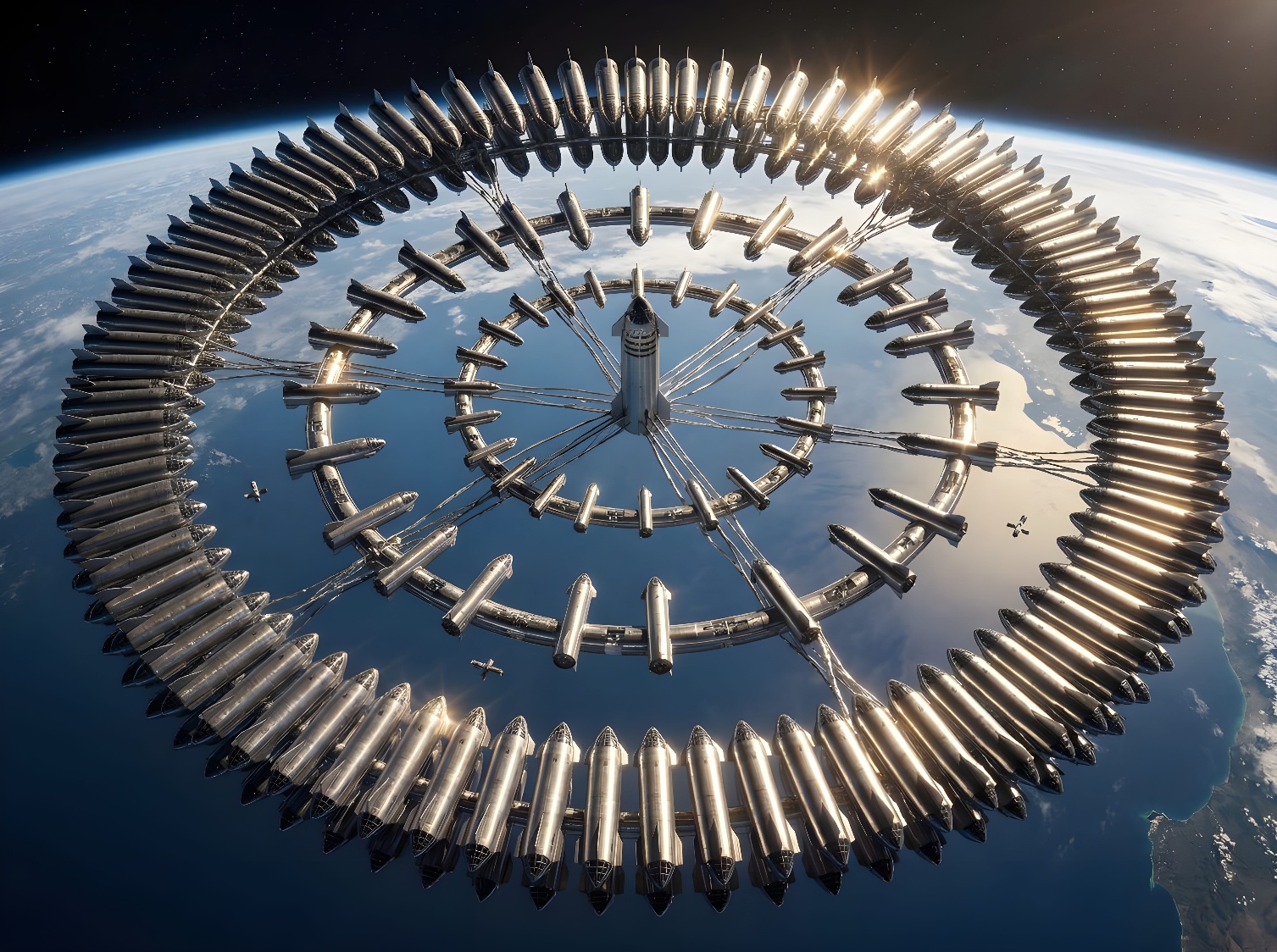
By implementing Advance Market Commitments (AMC) and milestone prizes, the United States can de-risk private investment, accelerate development, and secure strategic leadership in human spaceflight. The project delivers critical artificial gravity research, long-duration life support testing, in-orbit manufacturing platforms, and a scalable stepping stone to cislunar and Martian operations. The design is inherently expandable into a full megastructure with concentric rings for variable gravity and vast real estate.
Primary Goal: Establish a functional, rotating American orbital habitat with minimum 12–18 crew capacity by 2030, with clear pathway to megastructure expansion.
Key Innovation: Centrifugal artificial gravity via tethered Starships eliminates major barriers to long-duration human spaceflight. Two Starships are tethered nose-to-nose with a 1-mile tether, with the third at the central pivot point for propulsion and manoeuvring without de-spinning. This arrangement requires no major in-orbit construction and can be scaled into full megastructures.
Unique End-of-Life & Expansion Advantage: When the station reaches the end of its operational life in Low Earth Orbit, the entire tethered system is flown to Mars (or other destinations) intact, maintaining artificial gravity during the journey. Upon arrival in Mars orbit, the tethers are cut and the individual Starships land separately but as a coordinated group, forming an instant “mini-city” habitat on the surface. Short hops are possible for mobility. ISRU on the planetary surface allows Starships to be refuelled locally, turning them into efficient shuttles between surface and orbit. This reusability transforms what would normally be destructive deorbit into a foundational asset for planetary settlement.
The Problem
The International Space Station (ISS) is scheduled for deorbit between 2030 and 2031. The United States currently has no independent, long-duration human-rated orbital platform capable of supporting extended crewed missions with artificial gravity. Microgravity research is valuable, but sustained human health in space requires artificial gravity to combat bone loss, muscle atrophy, fluid shifts, and other physiological effects.
Traditional station designs are extremely expensive (ISS >$150 billion) and slow to develop. Meanwhile, China is advancing its Tiangong station and lunar ambitions. The U.S. needs a faster, cheaper path to maintain leadership in human spaceflight.
The Solution: Tethered Starship Habitat & Scalable Megastructure
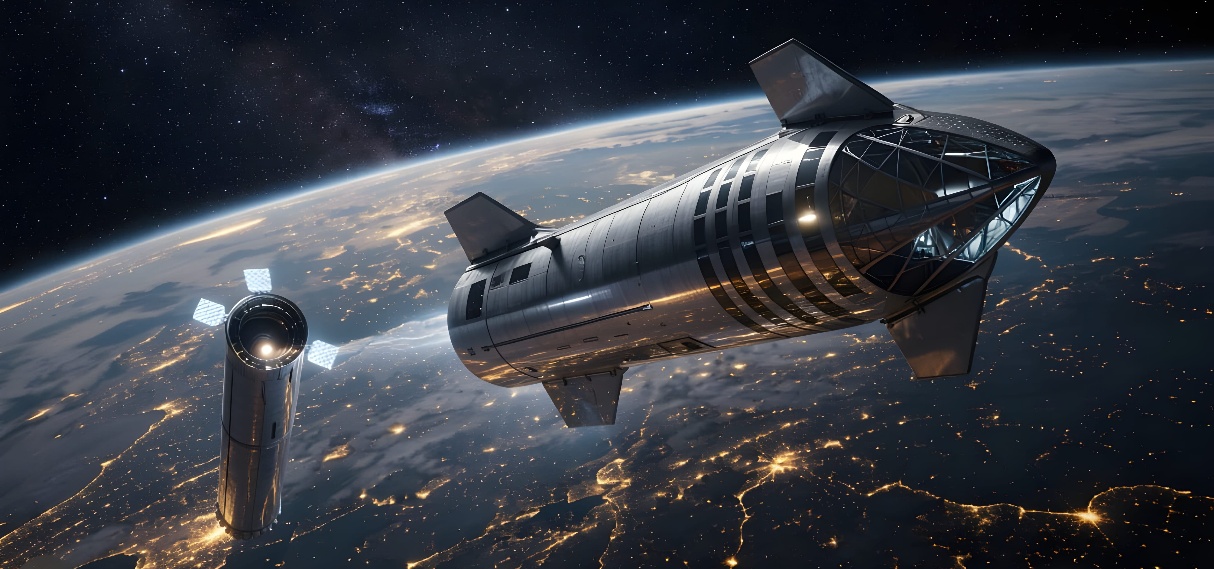
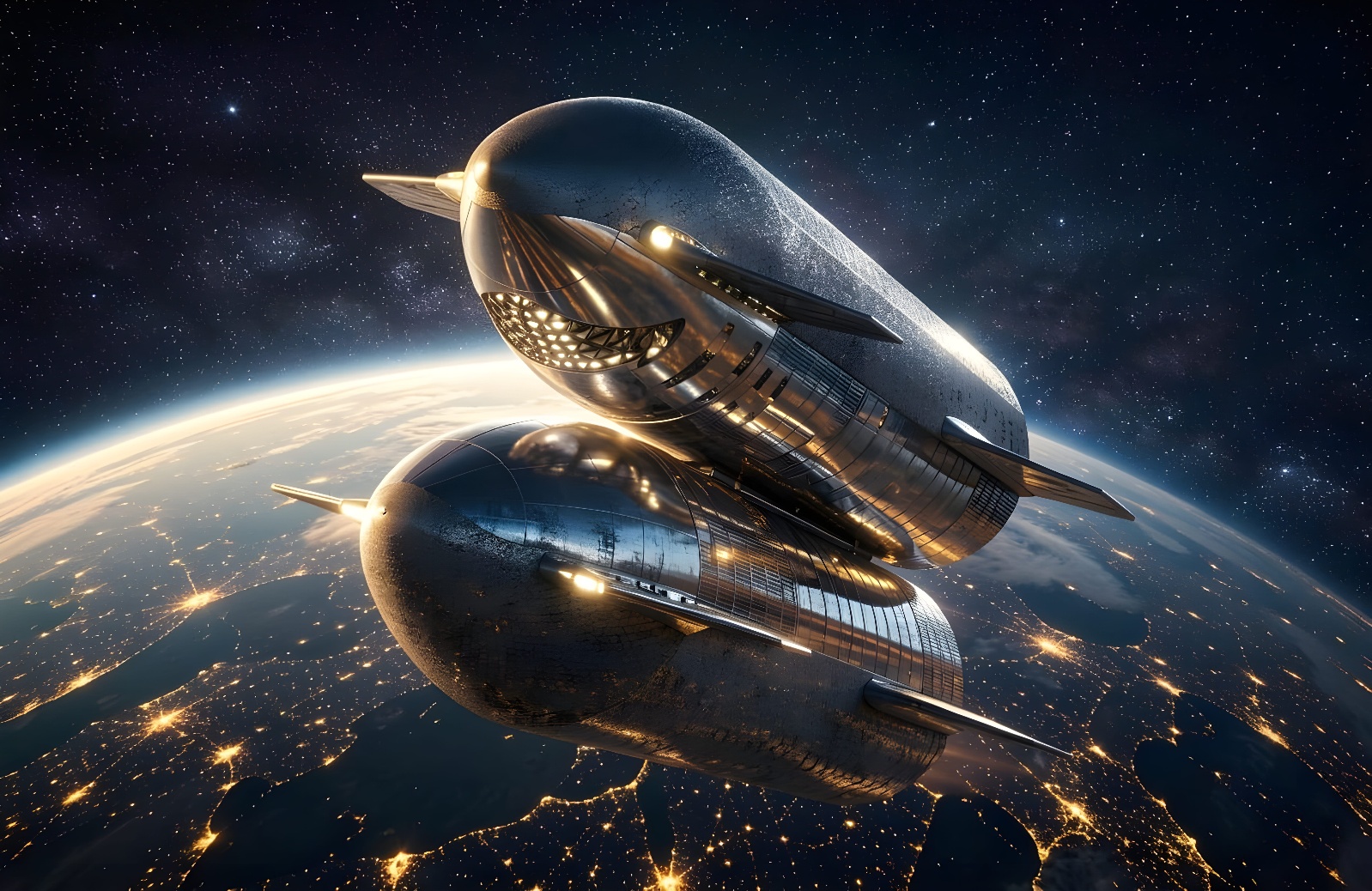
Three Starships are launched to orbit. Two are docked nose-to-nose and connected by a 1-mile (1.6 km) tether. The third Starship is positioned at the central pivot point, providing propulsion, manoeuvring, and cargo delivery without the need to de-spin the habitat. The entire structure is spun at approximately 1 rpm to generate ~1g of artificial gravity at the crew modules.
Key Technical Features:
Tether length: ~1 mile (adjustable for desired g-force)
Rotation rate: 1 rpm → ~1g artificial gravity (comfortable for long-duration missions)
Crew capacity: Initial 12–18, scalable with additional Starships
Elevator system: Runs along the tether for crew and cargo movement
Emergency capability: Tether can be cut, turning each Starship into an independent lifeboat (depth of redundancy)
Continuous Thrust Capability: The central Starship enables thrust and maneuvering while maintaining artificial gravity.
Major Strategic Advantage – True Reusability & Megastructure Potential:
At end-of-life in Low Earth Orbit, the entire tethered system is flown to Mars (or other destinations) intact, maintaining artificial gravity during the journey. Upon arrival in Mars orbit, the tethers are cut and the individual Starships land separately but as a coordinated group, forming an instant “mini-city” habitat on the surface. Short hops are possible for mobility. ISRU on the planetary surface allows Starships to be refuelled locally, turning them into efficient shuttles between surface and orbit. The design scales into full megastructures with concentric rings at different radii, providing variable gravity zones, vast real estate for living, manufacturing, and large-scale crop production in space for use in space — a complete seed for a new branch of human civilization, built with depth of redundancy as a core principle.
Advantages Over Traditional Designs:
No major in-orbit construction required — uses existing Starship hardware and flight cadence.
Reusable and upgradable.
Dramatically lower cost than traditional stations.
Dual-use: research, manufacturing, tourism, deep-space mission training.
Market-Shaping Policy Mechanism
Advance Market Commitment (AMC) + Milestone Prizes
The U.S. Government announces a binding commitment to purchase operational habitat services upon successful demonstration of milestones:
Milestone 1 (2027): Successful uncrewed tether deployment, spin-up, and stability validation.
Milestone 2 (2028): First crewed rotation with confirmed artificial gravity health benefits.
Milestone 3 (2029–2030): Full operational habitat with minimum 12–18 crew capacity and significant U.S. industrial content.
Prize Pool: $500 million – $1 billion, paid only upon verified success.
Success Metrics (Clear, Performance-Based):
First crewed artificial gravity habitat operational by 2030.
Sustained minimum 0.8–1g at crew level for minimum 90 days.
Continuous thrust capability demonstrated while maintaining artificial gravity.
At least 60% U.S. industrial content.
Cost per crew-day significantly below current ISS levels.
Estimated Cost, Timeline, and Leverage
Public commitment: $800 million – $1.5 billion (paid on milestones only).
Private leverage: Expected 3–5x public investment from SpaceX and U.S. aerospace partners.
Timeline: Aggressive but achievable with Starship’s flight rate — first crewed habitat by 2030.
Strategic Benefits for U.S. Leadership
Rapid restoration of independent U.S. human spaceflight capability post-ISS.
Critical artificial gravity research for Moon and Mars missions.
Economic growth through American manufacturing and commercial services.
Strong national security applications.
Inspiration for a new generation of American scientists and engineers.
Technical Appendix
Artificial Gravity Math (Simplified):
Radius (R): 0.5 miles
Angular Velocity (Ω): 1 rotation/minute
Centripetal Acceleration (A): ~0.9–1g (comfortable range)
Studies (NSS, NASA) indicate 1–3 rpm is generally acceptable for long-duration missions, with higher rates possible for adapted crews. Tether stresses and materials (high-strength carbon composites or Kevlar derivatives) are within current engineering capabilities.
Conclusion
The American Space Station NOW is near-term engineering reality using existing Starship hardware. By using proven market-shaping tools, the United States can secure a permanent orbital presence, advance human spaceflight, and demonstrate bold leadership at a fraction of traditional costs. Most importantly, the design scales into a mobile megastructure that can travel across the Solar System, maintaining artificial gravity en-route, then land as a coordinated group to form an instant mini-city — providing a complete seed for a new branch of human civilization, built with depth of redundancy as a core principle.
The time to act is now